
Ship log
Build projects that agents can actually use
Agent-native software — Post Bridge, Composio, Browserbase, Arcade — and why the next side project should expose tools, not just another human UI.
I’ve been staring at the same fork in the road a lot of physician-builders are hitting.
You can ship another dashboard. Another CRUD app. Another “AI wrapper” with a nice landing page. Cursor and Claude will help you build it in a weekend — which is also why someone else can rebuild the UI in a weekend.
Or you can build something an agent can plug into — tools, auth, an MCP endpoint, a skill file — so Cursor, Claude Code, ChatGPT, Grok, or a Discord bot can do the work without clicking through your screens.
That second category is what people keep calling agent-native. I think it’s the more interesting bet if you care about projects that still matter when the model gets better at cloning frontends.
I keep a public scoreboard of that question at isitaiproof.com — is this still standing in ten years? This essay is the builder version: what should you ship if agents are the next distribution channel?
What I mean by agent-native
I don’t mean a chatbot bolted onto the marketing site.
I mean the product’s real surface is something an agent can call: named tools with schemas, an API with boring auth, maybe a SKILL.md or CLI so the agent knows the workflow. Often the core loop doesn’t need a UI at all.
The human still buys. The human still connects accounts and pays. The agent is the operator.
That’s a different product than “please open our app every day.”
Post Bridge — posting as a tool, not a tab
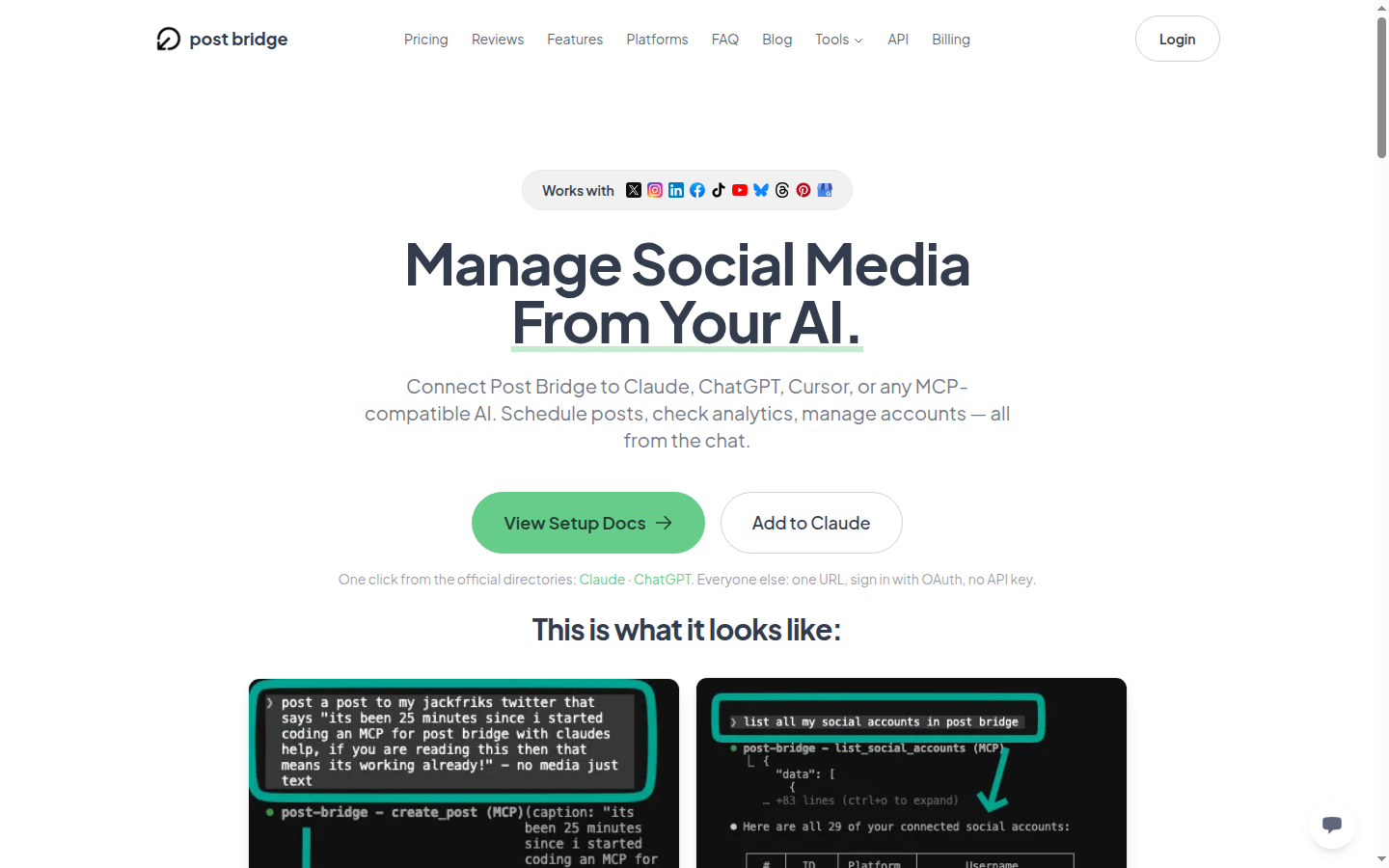
The cleanest consumer example I’ve looked at lately is Post Bridge.
On the surface it’s a social scheduler — Instagram, TikTok, YouTube, X, LinkedIn, Facebook, Pinterest, Threads, Bluesky. The interesting part is Agent Mode / MCP: one URL, OAuth or an API key, and your coding agent can schedule posts, upload media, and pull analytics from chat.
Their agents page is blunt: stop babysitting nine native apps; give the agent the posting tools.
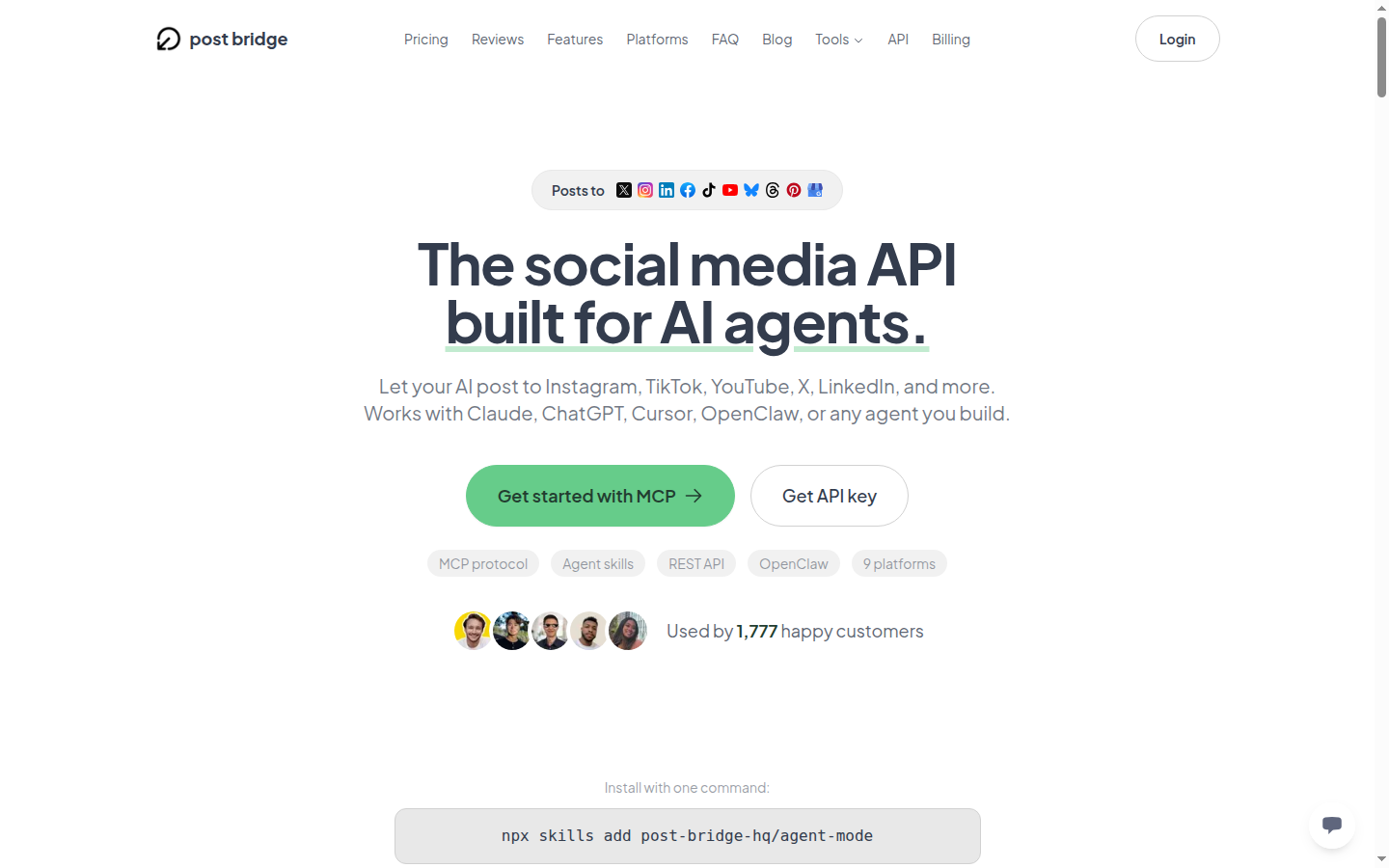
There’s a public agent-mode repo with a skill file so the agent learns the workflow, not just raw HTTP. That’s the pattern I keep seeing: product + MCP + skill.
Post Bridge is already in the isitaiproof catalog under social / integrations. People are still arguing AI-proof vs at-risk there, which is fine — the point is this shape of company is on the board.
Same shape, different layers
A few others that rhyme:
Composio is the plumbing shelf — connectors so an agent can talk to hundreds of SaaS apps without you hand-rolling OAuth for each one. Also on isitaiproof. If Post Bridge is “posting as a tool,” Composio is “don’t rebuild auth for Gmail and Linear again.”
Browserbase is managed browsers for agents that still need the open web. Paul Klein has been public about MCP-style tools (navigate, act, extract) instead of dumping raw Playwright into every prompt. When the site wasn’t built for agents, you give the agent a browser that was.

Arcade sits on the boring-hard problem: permissioned actions for real users — Slack, Google, Salesforce — without stuffing refresh tokens into the model context.
Agent-Native (Builder.io) is a framework bet: define an action once and expose it to UI and agent and MCP and CLI. Same work, multiple callers.
You don’t need their framework to steal that idea. One capability. Multiple callers.
Closer to home
I already run a small version of this without calling it agent-native.
The Physician Forge Discord bot answers /ask with Grok, grants membership roles after Stripe, and lives where the conversation already is. Discord is the client. The bot is the tool surface. Members don’t need a separate “AI portal.”
Same instinct as Post Bridge — put the agent where people (or other agents) already work.
What I have not shipped yet, and keep meaning to: a real MCP endpoint for pieces of Physician Forge, OrthoAndSpineTools, or The Direct Care List, so Cursor in someone else’s project can query or post without scraping the site. This essay is partly a note to myself.
Why this is harder to one-shot
isitaiproof exists because a lot of SaaS is a thin UI over a model call. Those get cloned.
Agent-native products tend to stack different stuff. Connected accounts — OAuth to nine social platforms, or a bank, or something EHR-adjacent — are painful to rebuild. Trust matters when the agent can post as you, move a calendar, or charge a card; people don’t reconnect that lightly. If Cursor or Claude or ChatGPT or Grok can discover your MCP, you ride their install base. And the ops layer — retries, media transcodes, per-platform caption rules, analytics sync — is why the skill file exists. The edge cases are the product.
None of that makes you immortal. It does change the question from “can AI redraw my screens?” to “will people hand an agent the keys to this?”
What I’m asking myself before the next build
What do I already do manually that I wish Cursor could just finish?
Can I expose that as a short list of named tools with boring auth?
Is the human UI optional — agents first, dashboard second?
Would I list it on isitaiproof without laughing, or is the only moat “we used GPT”?
If you’re hunting examples with the tabs open: post-bridge.com/mcp, composio.dev, browserbase.com, arcade.dev, agent-native.com, and the vote board at isitaiproof.com.
Build something an agent can use without opening a tab. That’s the work that still feels like leverage when the next model ships.
Keep reading
- What agent-native and MCP actually meanPrimer + fifteen project ideas that aren't another chatbot.
- Why it's so hard to make money on the internetHonest traffic numbers from this site.
- When you're already a spine surgeon, why build software?Fun + replacing clinical income.
- I got tired of running five Discord bots, so I built oneGrok in Discord — an agent surface we already run.
- Don't Quit Medicine. Build Leverage.Keep the license. Build anyway.
- We built our own analytics (no Google) — and how to add GA anywayHow Physician Forge tracks humans, bots, and AI referrals on a VPS with SQLite — public Stats walkthrough, the durability prompt that keeps deploys from wiping history, Cursor briefs for non-coders, plus optional Google Analytics.