
Ship log
When you're already a spine surgeon, why build software?
Fun, the challenge of replacing clinical income, and what disability stats + insurance gaps actually look like when your paycheck depends on your hands.
People ask me this a lot.
You’re already a spine surgeon. The training is done. The income is there. Why stay up building Ortho & Spine Jobs, The Direct Care List, OrthoAndSpineTools, this site?
The honest answer is shorter than people expect: for fun, and because I want the challenge of replacing my clinical income with something that pays when I’m sleeping, on vacation, or — worst case — when I can’t do the job anymore.
Everything else in this essay is just unpacking that.
The W2 is a body contract
If I step away for an hour, or a day, or a week, I am not making money as a surgeon. That sentence has been in my head for years. I wrote a version of it in the financial freedom essay.
Medicine is a great job. It is also a contract that assumes:
- my hands work
- my neck and back hold up
- my mind stays sharp under lights
- I keep showing up on someone else’s schedule
Disability insurance is how most of us paper over the first three. Vacations and sleep income are not what that policy is for. Neither is “I want to cut OR days because I feel like it.”
So I started asking a different question: what would it look like to own something that works while I don’t?
How common is injury and disability for surgeons?
I don’t want vibes. I want papers.
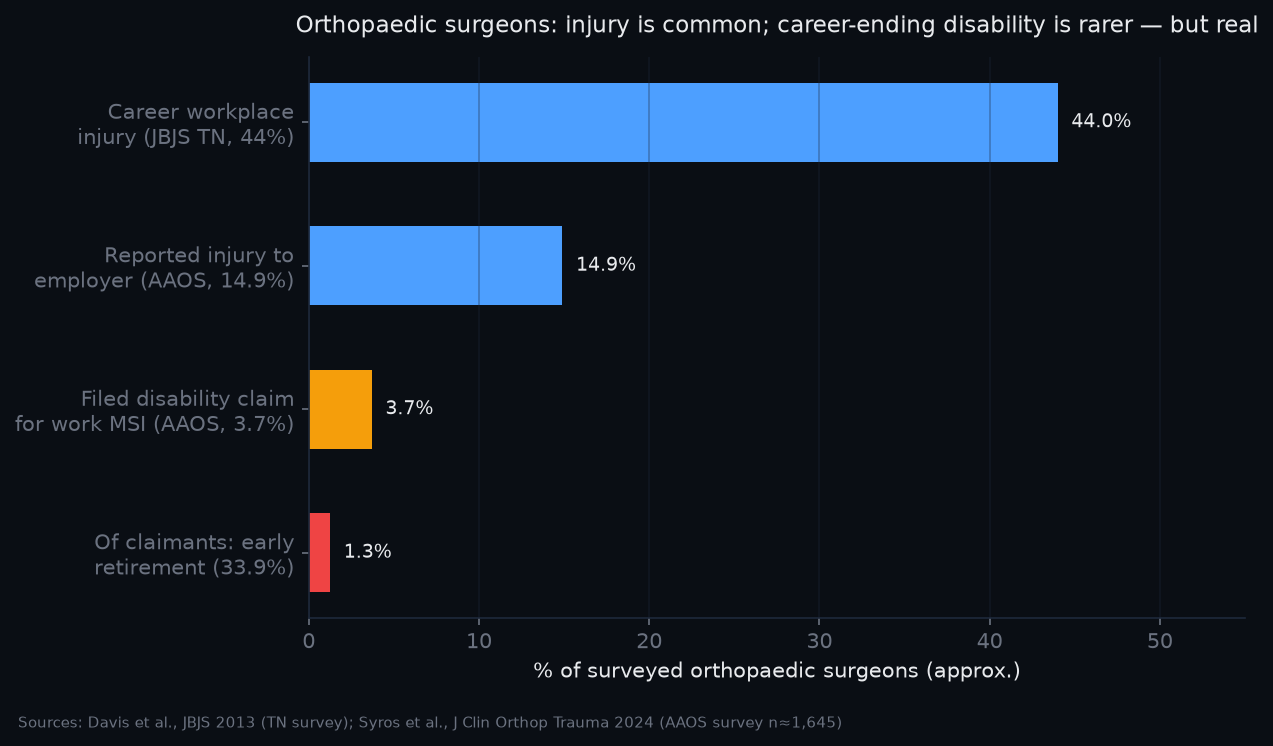
A Tennessee survey of orthopaedic surgeons (Davis et al., JBJS, 2013) found 44% reported at least one workplace injury during their career. Peak injuries sat in the 21–30 years-in-practice window — right when you’re supposed to be hitting your stride. Hand and lower back topped the list. About 10% missed work; 4% missed at least three weeks.
A larger AAOS member survey (Syros et al., Journal of Clinical Orthopaedics and Trauma, 2024, n ≈ 1,645, ~7% response rate — so treat it carefully) found:
- 14.9% had reported a work-related injury to their employer
- 76.4% said they had active disability insurance
- 3.7% had filed a disability claim secondary to a work-related musculoskeletal injury
- Of those claimants: 66.1% returned to work, 33.9% took early retirement
- Of those who returned, only about 53% resumed their prior workload; the rest came back at roughly two-thirds of baseline on average
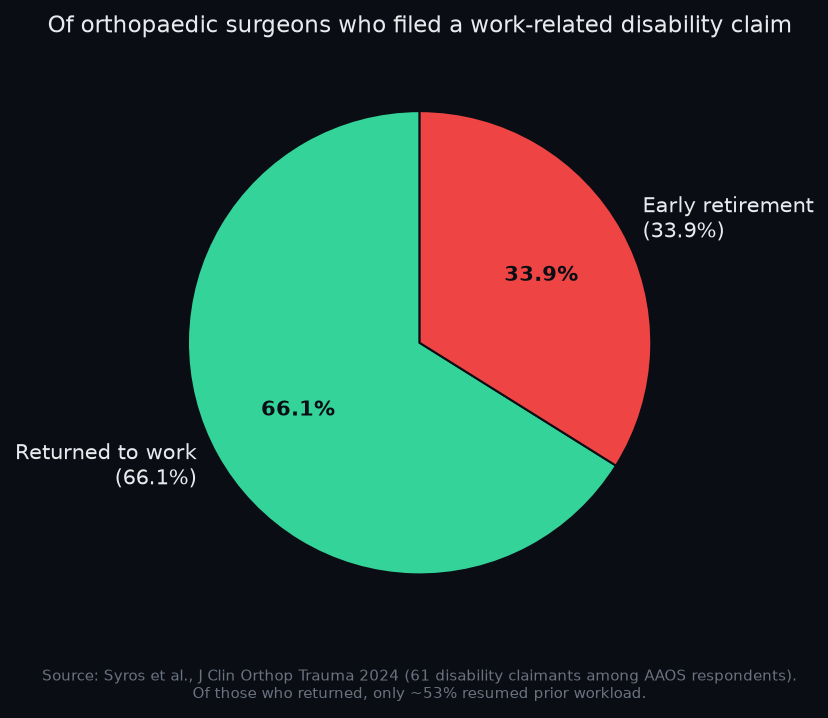
Read that carefully. Career-ending disability from a reported work MSI claim is uncommon in absolute terms — low single digits in that survey. But if you are one of the people who files, one in three never return, and half of the ones who do don’t get their old volume back.
An Austrian ortho/trauma survey put career occupational injury around 54%, with about 4% reporting incapacity to work from those injuries (Arch Orthop Trauma Surg, 2024).
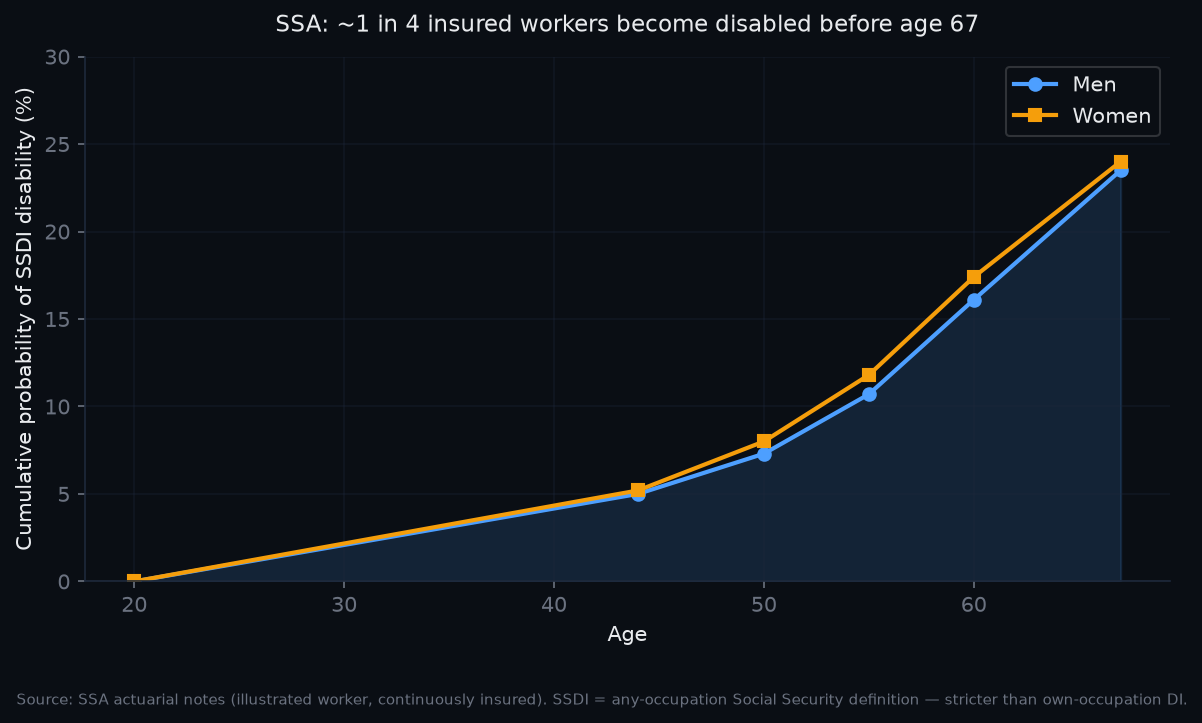
Zoom out past ortho. Social Security Administration actuarial tables still put the lifetime chance that an insured worker becomes disabled before normal retirement age around one in four (~23–24%). That’s SSDI’s definition — any occupation you can do, not “own occupation as a spine surgeon.” Own-occupation policies are different animals. The SSA number is still useful as a reminder that disability before 67 is not exotic.
Industry rule of thumb you’ll hear from disability brokers: you’re several times more likely to need disability coverage during your working years than to die and need life insurance. The exact ratio depends on age and table. The direction does not.
Is disability insurance enough?
Often: necessary, not sufficient.
Own-occupation coverage for a surgeon is one of the better financial products you can buy early. I am not arguing against it. I carry it. Most of the AAOS respondents in that 2024 survey did too.
Gaps I keep thinking about:
1. Definition risk. “Own occupation,” “modified own occupation,” residual / partial disability, mental-nervous limitations, elimination periods — these clauses decide whether a cervical disk that ends your OR life still pays. Policy language is the product.
2. Benefit vs lifestyle. Policies replace a slice of earned income. They do not buy optionality. They do not pay you to take three more weeks of vacation because your kids are young. They do not fund the version of life where you operate two days a week because you want to.
3. Partial return. Look at the AAOS claimants again — almost half who returned came back below prior volume. Residual disability riders matter. So does having income that isn’t tied to RVUs.
4. Insurer failure. Rare. Not zero. State life & health guaranty associations step in when a carrier is liquidated (NOLHGA overview). Disability income benefits are commonly capped around $300,000 (state-dependent — check your state’s association). For a high-earning surgeon with large monthly benefits, that cap can be a haircut, not a soft landing. Coverage can continue under the association or a assuming carrier, but history has examples of delays and incomplete make-wholes (the Chicago Fed has written about guaranty-fund limits and cases like Executive Life and long-term care insolvencies). Banking has FDIC. Disability insurance has a thinner net.
5. You still only get one body. Insurance pays after the bad day. It does not diversify the asset that is you.
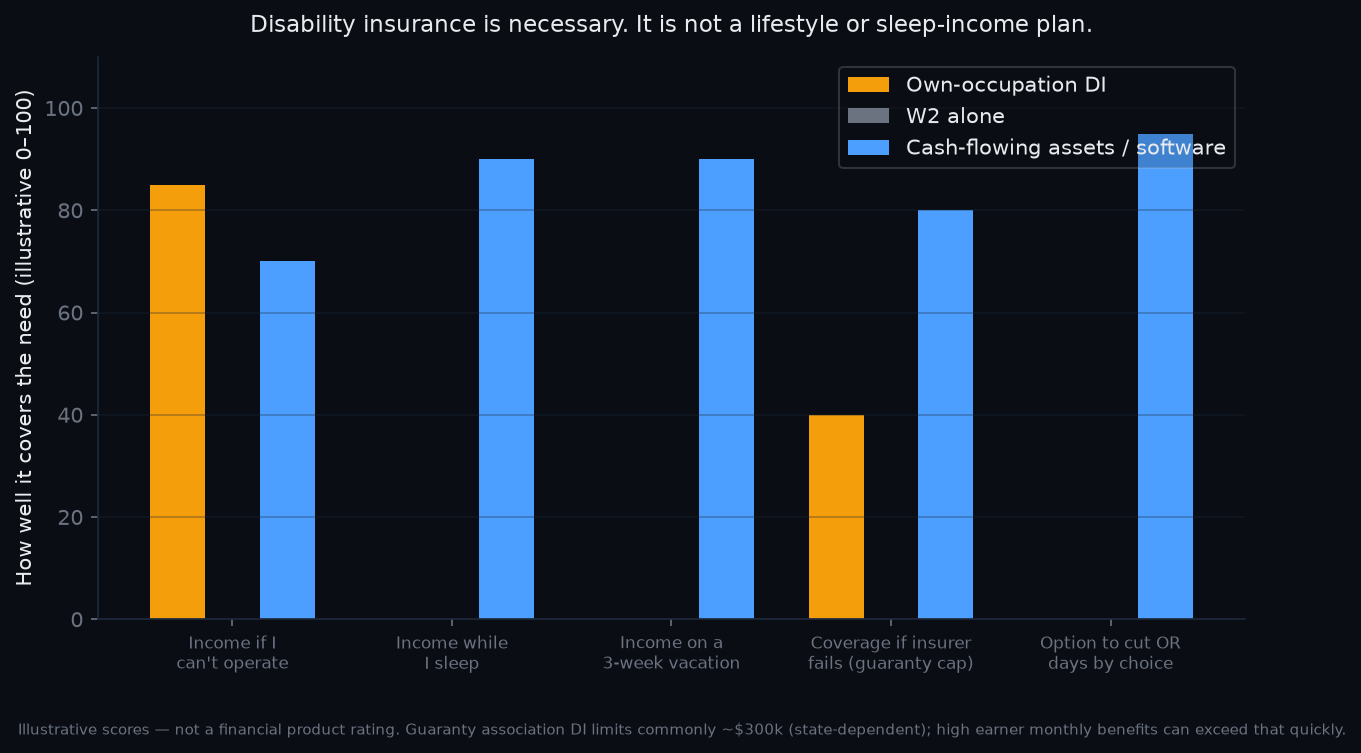
That last chart is illustrative, not a product rating. The point is the shape: DI is strong at “I can’t operate.” It is weak at “I want to sleep,” “I want more vacation,” and “I want the option to walk away without a claim.”
What if I just want more vacations?
Then disability insurance is the wrong tool.
Vacations are a cash-flow and control problem. If the only way the mortgage clears is OR time, every week off is a negotiation with yourself. If something else pays — software, a directory, a job board, a practice you own equity in — the negotiation changes.
I don’t need the software to replace 100% of clinical income next year. I need it to matter — enough that a slow clinic week or a long trip doesn’t feel like lighting money on fire. The stretch goal is full replacement. The near-term goal is optionality.
Same logic for sleep. A surgeon’s W2 does not accrue while you’re unconscious. A product with subscriptions, listings, or usage can.
Fun is not a trivial reason
I should say this plainly, because physician culture treats fun like a rounding error.
Building is fun for me. Shipping a MAUDE chart, a job board filter, a Discord bot that actually grants the right role — that scratches the same itch as figuring out a hard case, just without fluoroscopy.
If it were only grim risk management, I would have quit already. The risk case makes it worth the nights. The fun is why the nights keep happening.
What I’m actually trying to build
Assets that:
- can earn when I’m in a case, asleep, or on a beach
- compound skill (I get better at product, distribution, code)
- sit in niches I understand — ortho, spine, direct care, physician-builders
- might one day out-earn the W2 without requiring me to hate medicine
I still like taking care of patients. The goal in the financial freedom essay still holds: build and acquire assets that work for me, that can surpass W2 earning ability, and keep doing surgery because I want to — not because the spreadsheet holds a gun to my head.
Disability insurance stays. Index funds stay. The software is the third leg — the one that answers “what if the body contract ends early” and “what if I just want my life back some weeks” without waiting for a claims adjuster.
So why build?
Because it’s fun.
Because replacing clinical income is a hard problem and hard problems are interesting.
Because the literature says orthopaedic careers chew on necks, hands, and backs more than we admit in the lounge.
Because even good disability coverage has definition risk, partial-return gaps, and a guaranty-association ceiling that may not match a surgeon’s benefit.
Because vacations and sleep income are not insurance products.
Because I want freedom and security that don’t vanish if I can’t keep doing this job — or if I simply choose, some years, to do less of it.
That’s the whole answer.
Keep reading
- What I Wish I Would Have Known About Building Financial FreedomWhere the W2 plan stops and assets start.
- Don't Quit Medicine. Build Leverage.Keep the license. Build anyway.
- Why it's so hard to make money on the internetHonest traffic numbers from this site.
- Why Physicians and PhDs Make Excellent FoundersWhat transfers from clinic to company.
- We built our own analytics (no Google) — and how to add GA anywayHow Physician Forge tracks humans, bots, and AI referrals on a VPS with SQLite — public Stats walkthrough, the durability prompt that keeps deploys from wiping history, Cursor briefs for non-coders, plus optional Google Analytics.
- Cursor for people who don’t code — download, open a folder, give it a jobA physician-friendly Cursor onboarding: install, open a folder, Agent vs Ask vs Plan, screenshot walkthroughs, and the exact prompts to paste for your first small win.